


End Plastic Pollution
Developing AI-powered tools and research for global and statewide policymakers, reporters, and the public that reveal a world without plastic pollution is possible
Our Impact Worldwide
Decisionmakers have been working together since 2022 to address what the United Nations calls “a serious environmental problem at a global scale.” Ultimately, leaders are working to create the first-ever international legally binding treaty on plastic pollution. DSE, academic leaders in plastic pollution, and our partners at the Benioff Ocean Science Lab developed a cutting-edge model that predicts the global production, use, and fate of plastics through 2050.
Key Findings
Our research (published in Science in 2024) reveals an unprecedented opportunity to reduce global plastic pollution by 91% by 2050. Specifically, policymakers could implement a package four key policies up for consideration that work together across the entire plastic life cycle. A subsequent article we published in Science in 2026 recommends strategies to improve data reporting efforts and ensure actionable solutions can be reached via the Global Plastics Treaty.
Interactive Model
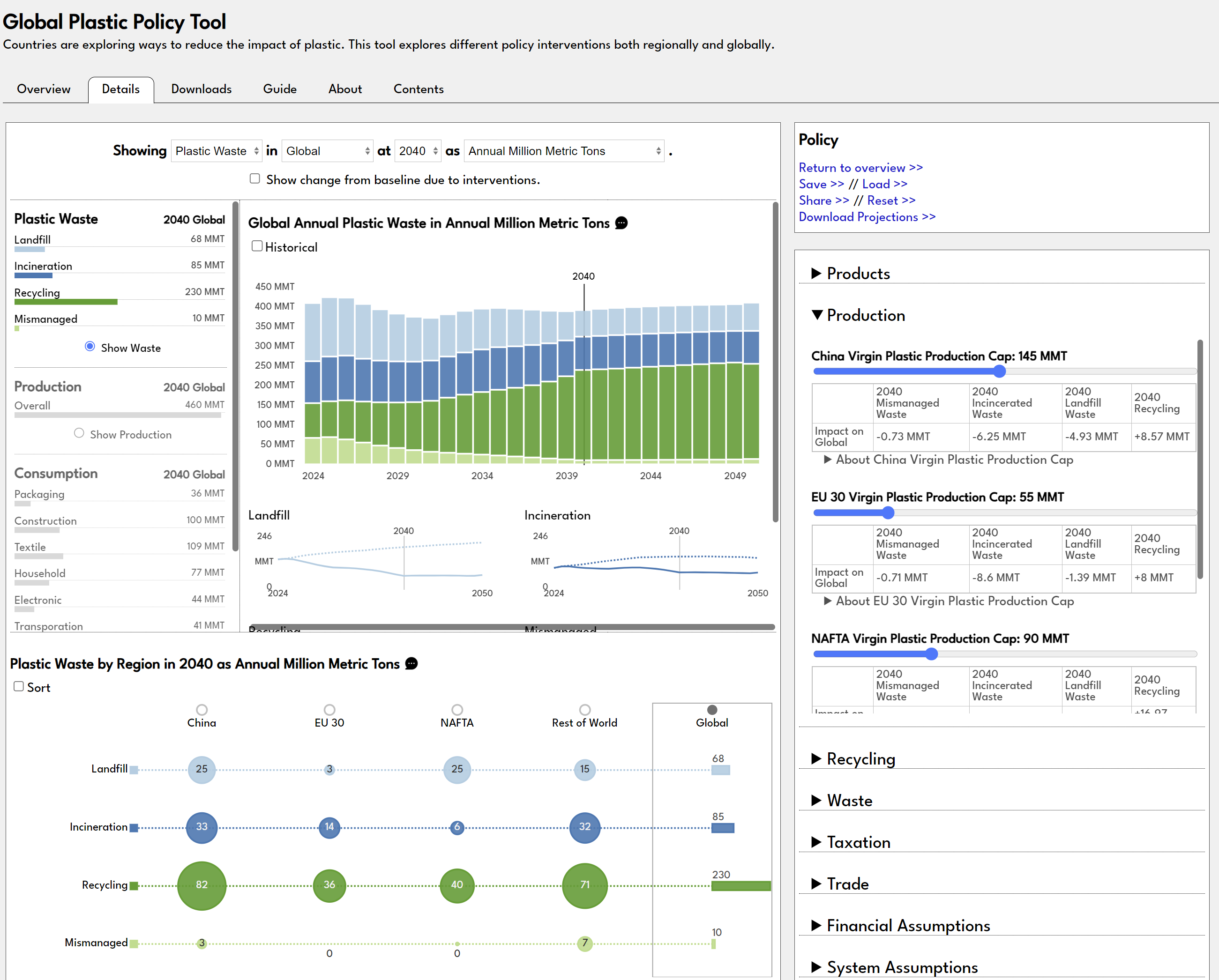
Our open source, AI-powered model enables policymakers to examine combinations of policies at different levels to inform their negotiation positions. Moreover, it analyzes the impact of eight specific policy interventions on ending plastic waste and lowering greenhouse gas emissions, both individually and when combined.
Simulating Impacts of Low Ambition versus High Ambition Treaty
We developed an interactive tool that provides an evidence-based projection of the the amount of plastic produced in 2050 under various policy scenarios. For eample, using our tool we can see the significant difference in impact of a low ambition versus a high ambition treaty (piled on top of Manhattan, for scale).
Open source data is available at https://github.com/SchmidtDSE/plastics-prototype.
Image

| Image

|
Disseminating our Research
We worked collaboratively with stakeholders to ensure this suite of tools are accessible and useful to policymakers throughout the treaty negotiations process. This included:
- Personally briefing global and national delegations and White House officials on our model, interactive simulation, and published findings throughout the negotiations process
- Faculty Co-Director Douglas McCauley spoke on a Newsweek panel, where he shared the opportunity and impact potential of roadmaps surfaced by the tool at the World Economic Forum’s Annual Meeting in Davos.
- McCauley socialized the value of the tool at a convening of global ministers during New York Climate Week regarding how global leaders are coming together to help solve plastics pollution.
International Media Coverage
To date our research has been featured in over 600 US and international news outlets including the Associated Press, ABC7, The Guardian, The New York Times, Newsweek, NPR, Time, and the Washington Post.
Our Impact in California

In 2022 California Senate Bill 54 passed to reduce the use of single-use packaging and plastic food service ware statewide. In support of a statewide strategy to drastically cut plastic pollution, DSE is collaborating with partners to apply our scientific, technical, and design expertise to help decisionmakers better understand policy and environmental impacts/trade-offs and ultimately take more informed action. We are redirecting the learnings and expertise gained from our work with the United Nations to this statewide effort.
Currently DSE is analyzing single-use plastic production data from 2023 to help validate current baseline estimates of how much single-use plastic California actually consumes. Ensuring we have a robust and accurate baseline is important because SB54 stipulates that plastic producers will be required to reduce single-use plastic use by 10% in 2027 and 25% by 2032. In the same way defining baselines is critically important in the domain of climate change (e.g. The Paris Agreement target to limit warming to 1.5C draws its meaning from the agreed upon baseline temperate average prior to the Industrial Revolution), we aim to ensure a proper baseline for volume of single-use plastics is set against which the state’s targets are measured.
Future Vision
Although global treaty negotiations have not been finalized on the expected timeline, we have been heartened to see 100+ countries rally behind a treaty draft that includes many of the provisions to end plastic pollution that surfaced in our research. We are closely watching ongoing negotiations with the aim of supporting a high-ambition treaty, and our software remains relevant to this strategy. In California, we are continuing our analytical focus on producer data, and developing data visualizations to help policymakers, reporters, and the public understand the importance of determining an accurate baseline for plastic production.