Image
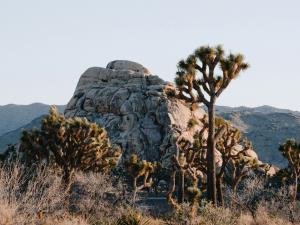
image of joshua Trees in the desert with large rocks in the background
Projects

Improve Wildfire Recovery in National Parks & Beyond

Helping land managers make quick and informed decisions for wildfire recovery with open source modeling tools

The Latest

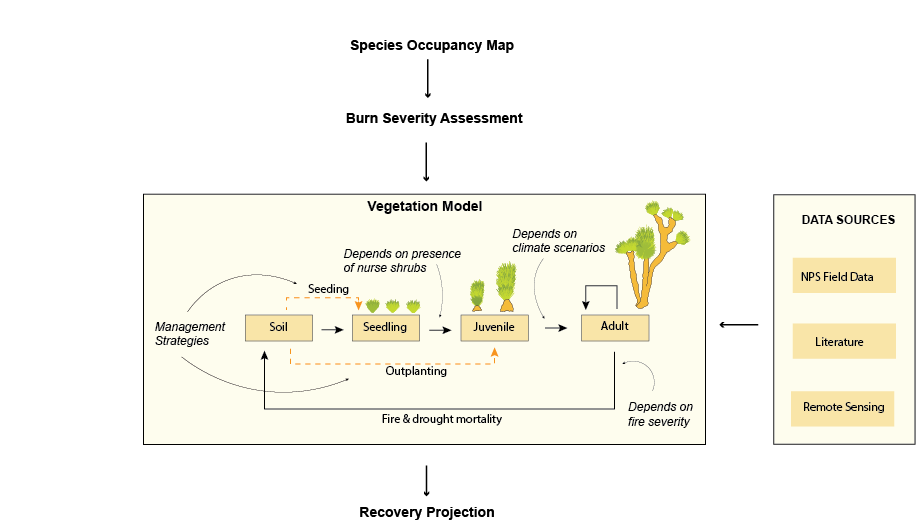
  • DSE and the National Park Service (NPS) co-designed a first-of-its-kind tool to help the agency make quick and informed decisions for wildfire recovery in California’s Mojave Desert. We are working to scale the tool for similar ecosystems.
  • Recently we supported NPS as it used the tool in real-time following two separate wildfires through Joshua Tree refugia.
  • We also developed new open source modeling software that makes vegetation modeling (critical for wildfire recovery) more accessible to those without programming or other technical backgrounds.


Our Impact

The Disturbance Recovery Tool is tailored for ecosystems in California’s Joshua Tree National Park and the nearby Mojave National Preserve. These areas provide refuge for the threatened Joshua trees and are facing more extreme wildfires due to climate change. Using the tool, NPS and the Bureau of Land Management can access satellite imagery to rapidly assess fire boundaries and receive real-time information on the severity. Consequently, land managers can make quicker management decisions immediately following a fire. 
 

Real-Time Use in the California Desert

Recently two wildfires burned nearly 300 acres through our focus areas. NPS used our tool to assess the fires’ boundaries, severity, and impacts on Joshua trees and other species of interest (i.e. oak, juniper, and yucca). Using the tool, NPS could immediately visualize the fires’ extent and utilized that data for response planning. Importantly, they could see and summarize burn severity among specific vegetation communities, which is crucial for decisionmaking, and used findings inform funding requests for post-fire recovery.


This visualization summarizes the hectares of vegetation burned and related burn severity (Refined Relative Burn Ratio) for each species impacted in the Black Rock fire (October 2025).
This visualization from the Disturbance Recovery Tool summarizes the hectares of vegetation burned and related burn severity (Refined Relative Burn Ratio) for each species impacted in the Black Rock fire (October 2025).


DSE and NPS were able to steadily advance our shared priorities during recent period of changes in government As a continued testament to the value of this collaboration, NPS granted Schmidt DSE a second round of funding on this project. 


NEW: Josh Model

Josh is a toolkit for scalable vegetation modeling that we are co-developing with NPS. Named after the Joshua trees that the software is tailored for, Josh aims to make efficient vegetation modeling more accessible, so that researchers can explore important questions about ecosystem management, fire recovery, and climate adaptation faster. In our experiments the model is about 60% faster than existing tools and requires about half the code.


Instead of writing complex computer code, NPS and other researchers can describe their models using a simple, vegetation-specific language that automatically handles crucial technical details required for performance. The same model can run in any web browser without installing software and then scale up to powerful computers when needed for larger studies. Most importantly, it bridges the gap between collaborators by providing sophisticated computational power through an easy-to-understand language. The platform is freely available and open-source.
 

How Josh Works

Josh helps make building spatial vegetation models easier for researchers. See below for step-by-step instructions to simulate agents, geospatial data, scalability, and stochastic behavior in the tool.


Recent Workshops

DSE hosted a workshop in the summer of 2025 to introduce the Josh model to our collaborators at NPS and UC Riverside and assess its utility. We are continuing to use the model to support NPS vegetation modeling efforts and making significant, ongoing improvements.


DSE team members with workshop attendees, including staff of NPS and the Bureau of Land Management, and faculty and PhD students from UC Riverside.
DSE with workshop attendees, including staff of NPS and the Bureau of Land Management, and faculty and PhD students from UC Riverside.


Future Vision

We are actively exploring opportunities to scale the disturbance tool for other similar ecosystems (e.g. non-forested, shrub-dominant, and arid or semi-arid landscapes). Relatedly, we are convening a working group with academic institutions that seek to use Josh for modeling sagebrush. We are starting to work with the United States Geological Survey (USGS) on a Josh modeling project that will aid the agency in improving vegetation modeling approaches.

Partner Feedback

Headshot for Nick Graver“Schmidt DSE provided our team with analytical tools that made the National Park Service better prepared to conserve species in the face of growing threats from wildfire, climate change, and staffing shortages.”


-Nick Graver, Botany and Veg Monitoring Program Lead, Joshua Tree National Park

News

Image
image of joshua Trees in the desert with large rocks in the background

DSE is Hiring a Data Analyst!

Join our team to support our work with the National Park Service. This full-time role is responsible for analyzing and preparing vegetation monitoring data. First review is 4/29!

April 16, 2025

DSE Contributors

  • Image
    Maya Weltman-Fahs

    Maya Weltman-Fahs

    Senior Program Manager
    Eric and Wendy Schmidt Center for Data Science & Environment at Berkeley
  • Image
    Nick Gondek

    Nick Gondek

    Data Scientist / Research Software Engineer
    Eric and Wendy Schmidt Center for Data Science & Environment at Berkeley
  • Image
    Kevin Koy

    Kevin Koy

    Executive Director
    Eric and Wendy Schmidt Center for Data Science and Environment at Berkeley
  • Image
    Amy Van Scoyoc

    Amy Van Scoyoc

    Postdoctoral Researcher
    Eric and Wendy Schmidt Center for Data Science and Environment at Berkeley
  • Image
    Amanda Anderson-You

    Amanda Anderson-You

    Data Visualization Developer
    Eric and Wendy Schmidt Center for Data Science and Environment at Berkeley
  • Image
    Maya Zomer

    Maya Zomer

    Postdoctoral Researcher
    Eric and Wendy Schmidt Center for Data Science and Environment at Berkeley
  • Image
    Lucia Layritz

    Lucia Layritz

    Postdoctoral Researcher
    Eric and Wendy Schmidt Center for Data Science and Environment at Berkeley
  • Image
    Sam Pottinger

    Sam Pottinger

    Senior Research Data Scientist / Software Engineer
    Eric and Wendy Schmidt Center for Data Science & Environment at Berkeley
  • Image
    Carl Boettiger

    Carl Boettiger

    Faculty Advisor & Associate Professor
    Environmental Science, Policy and Management at UC Berkeley
  • Image
    Maxwell Taniguchi-King

    Max Taniguchi-King

    Research Data Analyst
    Eric and Wendy Schmidt Center for Data Science and Environment at Berkeley
  • Image
    Andrew Shoenen headshot

    Andrew Schoenen

    Undergraduate Intern (Wildfire Recovery)
    Eric and Wendy Schmidt Center for Data Science & Environment